Sunday, January 11, 2015

From quiet-routine to the choatic-unexpected: The Cat In The Hat

All of us have different levels of enjoyment or even functionality in increasingly busy situations. Some of us do our best with quiet, routine, and fewer unexpected changes. Others of us do best when we have a nice balance of time alone, quiet, routine mixed with occasional social, busy, and novel experiences.

Still others of us seek and thrive on the unexpected, busy, chaotic, and always on the go lifestyles.
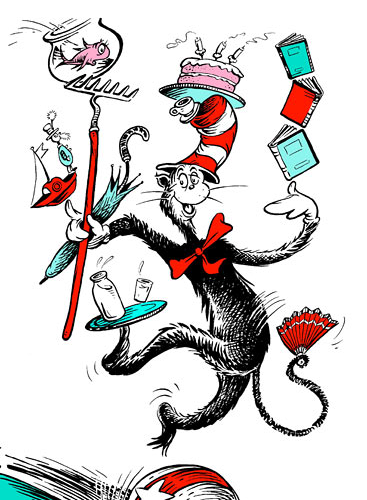
I know that I have always considered myself someone who thrives in change, novel, and I am incessantly curious. However, the more I have gotten to know myself, I simply do not function well without some significant down time full of quiet, routine, and decreased demands on me.

Take a moment to think about which one you might be.  Are you the fish that is nervous about all of the change and chaos or the cat who thrives on it? Maybe you are a little of both depending on the other stresses in your life at a given time.

Through my experiences with people with autism, they vary quite a bit, of course, but tend to be more on the thriving best under quieter, less dynamic conditions. Please remember that this tendency does not mean the person does not seek new, novel, intriguing experiences to learn, grow, and develop. We may just have to ensure a the new experiences in learning are manageable and not overwhelming into a realm causing stress and confusion.

Take some time this month to play with the levels of dynamics you are offering and when. If you are teaching a new game to your student or child, consider dropping all words except those that are absolutely essential to the game. You may see a huge change in your child/student's ability to integrate that new learning. Try eating a meal or snack with your child/student. Put music on, start talking more than usual. Observe not only your child/student's reaction, but your own. Is it easier or harder to focus and interact?

This month, we will be using the book The Cat in the Hat by the wonderful Dr. Seuss, to guide our activities. The book demonstrates so well the fear and anxiety that is provoked with the unexpected! Other topics that are explored, which you can too, are:

1.  Adding small changes or additions one at a time, deciding when too many is too much! (e.g., play ball with just one ball then add more and more until the two of you are feeling a bit overwhelmed, then deliberately remove one ball at a time until it is back to just one).

2.  Anticipation of what will happen next on each page (what will the Cat to next!?)

3.  Opening a box that you do not know what is inside... the anticipation, excitement then playing with whatever you had put inside for the discovery to happen.

4.  Saying "no!" for self-advocacy purposes... and sometimes needing to say it again more clearly (and ensuring others respect this answer).

5.  Cleaning up after oneself after playing (always a good one!)

And of course there are TONS of resources on the internet for fun activities surrounding this book:

PBS Activities Online and Printables

Dr. Seussville Online Games and Educator Resources

A printable maze for the cat to find his hat!

Specific activity ideas:

Creating a list/visual representation of rainy day activities vs. those you can do when it is sunny

Writing down words that come up frequently (e.g., cat or fish) on separate pieces of paper to then highlight when they come up when reading it

Make a recording of reading the book out loud.. for future listening more independently

Make and wear hats like the cat's

Playing ball

Making a cake

Hanging things on hangers (helpful around the house, too!)

Pouring water from one container into other containers (e.g., teapot) and measuring amounts

Tying and wearing bow ties and red ribbons in your hair

Using a rake in the yard for a bit of yard work

Carrying and balancing things on a tray (be careful to start with non-breakables!)

Making and flying a kite

Oh there are so many many many more ideas from this book!  Have fun and add here, if you feel so inclined! I and others would love to hear and share ideas!

Barb

Friday, December 26, 2014

2015: Promoting Curiosity and Exploration


"The future belongs to the curious. The ones who are not afraid to try it, explore it, poke at it, question it, and turn it inside out."

I loved being a kid. I remember poking things to see if they would move or change, adventuring to new locations, and simply touching fabrics in the store to see how they would feel as I trailed behind my mother and sister. These little moments of curiosity and discovery were significant learning events and too numerous to count. 

I find it fascinating and perplexing that one of the hallmarks of autism seems to be a significant difference in the experience of that CURIOSITY and subsequent exploration.  

When I mention curiosity, I am talking about that drive and that thirst for knowledge the propels us into the unknown with excited anticipation. That understanding that if we keep going, even when unsure, we may learn something new that will make life more interesting, engaging, efficient, or enjoyable. This is certainly not the "rule," but a generality, of course.  I meet people everyday who have autism who are certainly curious about many things, but those things are often decidedly different things than many others around them. And...honestly, this is exactly why I absolutely love so many of the people in my life who have autism. Their experience of curiosity is so different than my own. It seems so much more fragile most of the time.... until it takes hold. Then once it takes hold, it is a more powerful drive than any other for that person with autism. A child who may seemingly be so solitary and disengaged who then learns everything there is to know about trains or bridges. Then there are nonverbal children who may seem to not be paying attention who can manipulate any lock or electronic device.

Our human existence depends on curiosity combined with healthy common sense. For some reason, we are not yet fully able to understand, autism changes the brain's drive for knowledge and seemingly, the ability to perceive typical amounts of uncertainty as welcome challenges. 

Instead, uncertainty is often met with a drive for certainty, sameness, and a reduction of challenges to calm the internal system. 

Therefore, when a child's drive and thirst for knowledge (or intrinsic motivation) in not at full throttle, we are left following their lead versus being able to lead them into new realms of exploration and learning. Following a child's lead, of course, is necessary much of the time for early healthy attachment and development. However, the tables do need to turn (so to speak) for a child to learn from mentors, guides, and teachers in his life about the world and himself. 

A child's intrinsic motivation must be present for true learning to take place. Otherwise, we resort to trying to motivate a child using external motivators (rewards) for behavior that becomes more compliance based, lacking the drive for further investigation and learning.

Our goal for children with autism should be to:  

1.  Connect first - find out what motivates them, where they are with regulation and interest

2.  Provide tiny everyday moments to expand thinking and curiosity about the things that matter right then, in that moment (e.g., if they are lining up cars, add a truck - is a part of the schema? add a duck - is it the color that matters or the vehicle?) 

If you are truly curious about your child's mind, chances are, your child will propel himself into that curiosity, too.

3.  Continue to expand that curiosity and create a back and forth rhythm to your engagement and stretching of that muscle into next activities, new experiences, and new learnings.

Here is a positive article on promoting curiosity with children with autism, however it does seem more geared for fairly verbal children.  The concepts are clear, however, I just recommend using much less verbal language due to auditory processing needs.

"Curiosity is the wick in the candle of learning." - William Arthur Ward.

I will put this in "autism world terms," that intrinsic motivation must be at the root of learning. Beautifully, everyone's curiosity (or intrinsic motivation) is different. It is our job to spark or light that curiosity in children with autism in a way that feels manageable and intriguing!

Our themes this 2015-th year will center around books and poems written to spark that curiosity and intrigue while the hard work will be in the smaller moments between you and your child or student with autism. 

Questions?

Barb Avila
503-432-8760
bavilaconsulting@gmail.com


Wednesday, November 26, 2014

Theme for December: Anticipation

Hello Mindful Synergy Guides!

I hope that your American Thanksgiving will be peaceful, restful, and enjoyable. Somehow, I missed how we suddenly went from August to now December! How did that happen?

For November, we focused on "giving thanks," and supported students and those on the autism spectrum to think about and use the habit of saying "thank you," when you receive something from someone. Please continue this practice, as it will take them further than you may realize, with friends, neighbors, colleagues, and strangers.

We now move our attention to giving and receiving but highlighting the excitement JUST before one opens the gift! So get all of your creative juices flowing on the creation of holiday gifts for others... while focusing on a new foundational objective that is near and dear to my heart.

The foundational objective I would like for you to highlight for your student or child is the anticipation element of giving and receiving gifts. Waiting is one of the hardest skills for children to learn and one of the most exciting when there is a potentially pleasurable outcome! I think about that moment when holding a child's hand and you are looking at one another, about to see what is behind that door or in that box or what will happen when you touch that or jump off that.... that back and forth anticipatory engagement look is precious!  And so rarely enjoyed for and with a child with autism.

Across your day, choose moments when you can draw out (highlight) the moment of anticipation. When you are about to open that door, pause and connect with your child or student... gaze to one another to share the anticipation (NOT to have them mechanically request "open, please)....enjoy that moment with your child, even if brief. You can name that feeling if you'd like: "exciting," or "curious," if appropriate to your child's/student's level of communication.

Then when you are creating or choosing gifts for others, wrap them up and when you give them... do the same highlight on that excitement, curiosity, and anticipation of the other person opening the item. When receiving, take just a little longer to enjoy the moment of anticipation instead of tearing into that paper and wrapping.... to enjoy and savor that gorgeous moment of anticipation.

Happy giving. Happy receiving. Happy moments of anticipation.

Barb

Thursday, November 20, 2014

Gratitute can change your life!

I love this addition to our thinking about guiding  gratitude with people with autism!

THE SOCIAL BENEFITS OF GRATITUDE
By Philip Watkins, 2014

"We believe that it is because grateful recounting trains cognitive habits that in turn enhance happiness."


I personally grew up Catholic and we would say a thankful prayer to start our meals together. I am no longer a practicing Catholic, but find it very centering, calming, and collaborative to still say what we are grateful for to start our meals at home together as a family. It is a common recommendation to families with whom I work, to state 1 thing you are each grateful for today. If a person is not able to verbalize, there are other ways to help them communicate (e.g., visual supports, providing choices/options, and possibly to simply state a moment you observed them in their day being peaceful and seemingly grateful for something).

I am grateful for each of you and your mindful guidance of those with autism.

Barb Avila

Sunday, November 16, 2014

Giving thanks continued.... November 17-21, 2014

Hello Mindful Synergy Guides!

We are going to continue the theme of giving thanks by focusing our attention on an essential manner of saying "thank you." 

When I first started in the field of autism, I was pre-having my own child and very behavioral focused in my approach. I was very structured and no-nonsense. Therefore, when asked if a child should learn to say "please" and "thank you," I would usually say that I did not feel it was of utmost importance due to it being a nice-ity and very social based.

Soon, I had more experience with more children, teens, and young adults... and soon also had my own son. I learned that the students who were taught "please" and "thank you," were often the most integrated into general society. I still felt (and feel) that it was silly to have students try to "fit in" and still feel that it is our job to better understand autism while being more open to the variations of experiencing the world - vs. our changing their responses. However, when it comes to social graces, I have to say I think they are extremely valuable gems that all student with autism and without should be taught. Imagine ANY child who says "thank you" next to a child who simply takes what they want. The child who hesitates a moment to look back toward the person (not insisting on eye contact here), and saying "thank you," is a welcome guest in many situations. That same person may need to take a break or leave a busy or loud situation... and people surrounding him/her will be more accommodating just by nature.

Many of you are probably familiar with Temple Grandin. She is an amazing woman who is a designer of livestock handling facilities and a Professor of Animal Science at Colorado State University. She also has autism. She speaks internationally on both subjects.  Temple Grandin states: "When I was a child, I was expected to have good table manners and to say “please” and “thank you.” She advises parents to teach both "please" and "thank you," attributing her learning these to her mother, Eustacia Cutler, who also speaks about her experiences of parenting Temple Grandin.


I am including a very short video clip of how to say "thank you" in American Sign Language. I try to include a visual each time I say or use the wording, to provide full communication to those with autism. You can choose to teach your student to use the American Sign Language sign or a visual phrase of "thank you" written on a piece of paper or another visual provided (e.g., Board Maker or PECs visuals). I like using the sign due to its ease of use in any situation when another type of visual may not be available/handy.

As a reminder, we continue the 2 other very important foundations for social and learning engagement... as these are always going to be two of our foundations for guiding:

1.  Connecting at the beginning and at points within your activities. Be sure to remember that your connection with your student is MORE important than ANY task or activity you are doing. If your student cannot connect with you - meaning seeking your guidance, information, and knowledge in small moments of connection, then anything else you do will not be fully heard or integrated into your students' learning. They will either be in independent or compliant mode. Neither allows for you to truly engage and guide attention to new knowledge.

2.   Making sequencing known and something to involve your student in understanding. If you are always the one to sequence the day's activities, the steps to accomplish something, etc, when will your student learn to do so themselves? Involve them now, so that they see and understand the importance and the order of things. This is one significant step in being able to tell time, follow a calendar, follow a daily or weekly schedule, or more.

Let me know if you have questions, additions, or thoughts to share...

Barb

Friday, November 7, 2014

Spirit of Giving Thanks: Theme for November!

Hello Mindful Synergy Guides!

Welcome to November. I hope you have started it out well and are looking towards a peaceful holiday season. I have to admit that Thanksgiving is my favorite holiday. I enjoy the gathering of family, friends, and loved ones to give gratitude for one another and the bounty we enjoy in our daily lives.

I would like for everyone to support and guide activities that celebrate this idea of giving to others and especially giving thanks this month. Children on the autism spectrum are often mired in things being done TO them and/or FOR them. Let's take some time to show them that they too, have the desire and ability to give to others.

Please continue:

Connection is always first and foremost over any activity or task. If you are not connected, do not proceed. Take a moment (or two or three) to engage and connect with your student so that they can then hear your ideas, thoughts, and teaching.

Sequencing is an essential life skill that helps orient ourselves. Continue providing opportunities throughout your day and activities to support the understanding of the order of things (overall scheduling, recipes, stories, and more).

Ideas for new theme, integrating giving thanks:

Make a card for a neighbor and deliver it
•Make a card or write a note everyday and mail or deliver to different people
•Instead of just making a snack for oneself, make another to share with someone else
•Paint or create art for someone else
•Collect bare branches to create a "tree" to hang notes of thanks indoors
•Write down in the journal everyday: people or things you are thankful for
•Sing songs of thankfulness that you make up together
•Target saying "thank you" this month for things that are provided to him/her

And one of my all time favorites is shown in this picture --->
Are you a Pintrest fan?  Check out some thankful trees http://www.pinterest.com/ListPlanIt/thankful-tree-inspiration/

Another....
http://bluebirdbaby.typepad.com/bluebirdbaby/2010/11/gratitude-tree.html

Anyone want to add ideas? Email them to me or post them here, we would love the collaborative thinking!  And thank you!

Barb

Thursday, October 23, 2014

THEMES: Connect & Sequence - October 27-31st

Hello Synergy Guide Teams!

Good to see many of you over the last week or so. We had a couple of GREAT team meetings last Friday, including one which fully included our student in the meeting, who demonstrated her usual grace and enjoyment of being surrounded by many of you.

On Friday, I used an analogy of us being guides to move in a direction for and with our students... like a train leaving a station. We can take our time moving, we can support getting on, bringing luggage, ensuring understanding, etc.... but ultimately, the train is (you are) moving in a deliberate direction, a sequence, a schedule for the day which is full of wonderful adventures.  You can show your student the way and how to enjoy the view, the stops, the excitement, what there is to learn.

This quote (below) was posted today by an autism group on Facebook and I thought it was perfectly fitting for this analogy:

Bottomline, we are not worried about speed at Synergy. We wish to spotlight the role we have with our students, as guides. We wish to show them they can learn, grow, challenge themselves, and be inspired by the world and by you, their guide. One way we're currently targeting this trust in you as guides is to NOT speed up, hurry up, or rush but to continue to CONNECT FIRST. Then use your schedule for the day (however you offer that visually or verbally) to then move to the first activity. Then continue guiding according to the schedule or sequence of the day or time together, stringing together activities as much as you can, until you or your student indicate needing a break for sensory, exercise, snack, etc. Demonstrate and stay true to the sequence of the day together. For someone struggling with the environment being a bit chaotic or overwhelming, having a trusted person who gently yet confidently guides the way to see the sequence of things, could be such a relief and window in for learning in so many new ways!

So let's capitalize on the sequencing concept this next week and have fun with it!

I'll post more later but think about all the exciting sequences in every day life that we find so essential to our living:

Counting
The Alphabet
Planting seeds to grow
Taking items out to play with or manipulate, then putting them away
Writing our name
Starting a game, playing, then ending the game when someone wins (or there is a resolution)
Story lines!
Getting dressed
Brushing teeth

And so many more!!! Have fun with the theme.... focuses are on:

1.  Connect first and whenever needed for regulation and engagement
2.  Sequencing through the daily schedule
3.  Sequencing in general, in life, in chores, in leisure....

Let me know if you have any questions or concerns~
Barb